
 i/ˈɡɑːnə/), officially called the Republic of Ghana, is a sovereign unitary presidential constitutional democracy, located along the Gulf of Guinea and Atlantic Ocean, in the subregion of West Africa. Spanning a land mass of 238,535 km2, Ghana is bordered by the Ivory Coast in the west, Burkina Faso in the north, Togo in the east and the Gulf of Guinea and Atlantic Ocean in the south. The word Ghana means "Warrior King" in Mande.
The territory of present-day Ghana has been inhabited for millennia, with the first permanent state dating back to the 11th century. Numerous kingdoms and empires emerged over the centuries, of which the most powerful was the Kingdom of Ashanti. Beginning in the 15th century, numerous European powers contested the area for trading rights, with the British ultimately establishing control of the coast by the late 19th century. Following over a century of native resistance, Ghana's current borders were established by the 1900s as the British Gold Coast. In 1957, it became the first sub-saharan African nation to declare independence from European colonisation.
A multicultural nation, Ghana has a population of approximately 27 million, spanning a variety of ethnic, linguistic and religious groups. Its diverse geography and ecology ranges from coastal savannahs to tropical jungles. Ghana's economy is the ninth-largest on the Africa continent by purchasing power parity and nominal GDP. Ghana is one of the countries on the continent that produces petroleum and natural gas, with the continent's fifth largest oil reserves and sixth largest natural gas reserves. It is one of the world's largest gold and diamond producers,[citation needed] and is projected to be the largest producer of cocoa in the world as of 2015. Ghana's growing economic prosperity and democratic political system has made it a regional power in West Africa. It is a member of the Non-Aligned Movement, the African Union, the Economic Community of West African States (ECOWAS) and the Group of 24 (G24).
Etymology

1925 map of what was to become Ghana
The name "Ghana" was a possible source of the name "Guinea" (via French Guinoye) used to refer to the West African coast off Ghana (as in Gulf of Guinea).[23]
Ghana was adopted as the legal name for the area comprising four separate parts, which immediately before independence enjoyed distinct constitutional positions:[24]
- the Colony of the Gold Coast;
- the Colony of Ashanti;
- the Protectorate of the Northern Territories; and
- the Trust Territory of Togoland (under British administration).
History
Main article: History of Ghana
Prehistory
![[icon]](https://en.wikipedia.org/wiki/File:Wiki_letter_w_cropped.svg) |
This section requires expansion. (January 2015) |
Medieval kingdoms
Main articles: Kingdom of Ashanti and Kingdom of Dagbon

16th – 17th century Akan Terracotta, Metropolitan Museum of Art
Until the 11th century, the majority of modern Ghana's territorial area was largely unoccupied and uninhabited by humans.[28] Although the area of present-day Ghana in West Africa has experienced many population movements, the Akans were firmly settled by the 5th century BC.[29][30] By the early 11th century, the Akans were firmly established in the Akan state called Bonoman, for which the Brong-Ahafo Region is named.[29][31]
From the 13th century, Akans emerged from what is believed to have been the Bonoman area, to create several Akan states of Ghana, mainly based on gold trading.[32] These states included Bonoman (Brong-Ahafo Region), Ashanti (Ashanti Region), Denkyira (Central region), Mankessim Kingdom (Western region), and Akwamu Eastern region.[29] By the 19th century; the territory of the southern part of Ghana was included in the Kingdom of Ashanti, one of the most influential states in sub-saharan Africa prior to the onset of colonialism.[29]

A 1850 map showing the Akan Kingdom of Ashanti within the Guinea region and surrounding regions in West Africa.
The earliest known kingdoms to emerge in modern Ghana were the Mole-Dagbani states.[29] The Mole-Dagombas came on horse-backs from present day Burkina Faso under a single leader, Naa Gbewaa.[34] With their advanced weapons and the presence of a central authority they easily invaded and occupied the lands of the local people ruled by the Tendamba (land god priests), established themselves as rulers over them and made Gambaga their capital.[35] The death of Naa Gbewaa caused civil war among his children, some of whom broke off and founded separate states including Dagbon, Mamprugu, Mossi, Nanumba and Wala.[36][37]
European contact (15th century)
Main articles: Gold Coast (region) and Ghana (Commonwealth realm)

Chronicles of Pre-Republicanism (c. 15th century–6 March 1957), including Gold Coast legislative election, 1956.
In 1481, King John II of Portugal commissioned Diogo d'Azambuja to build Elmina Castle, which was completed in three years.[39] By 1598, the Dutch people had joined the Portuguese people in gold trading, establishing the Dutch Gold Coast (Nederlandse Bezittingen ter Kuste van Guinea) and building forts at Komenda and Kormantsi.[40] In 1617, the Dutch captured the Olnini Castle from the Portuguese, and Axim in 1642 (Fort St Anthony).[40]
Other European traders had joined in gold trading by the mid-17th century, most notably the Swedish people, establishing the Swedish Gold Coast (Svenska Guldkusten), and Denmark-Norway, establishing the Danish Gold Coast (Danske Guldkyst or Dansk Guinea).[41] Portuguese merchants, impressed with the gold resources in the area, named it Costa do Ouro or Gold Coast.[41]
More than thirty forts and castles were built by the Portuguese, Swedish, Dano-Norwegians, Dutch and German merchants; the latter German people establishing the German Gold Coast (Brandenburger Gold Coast or Groß Friedrichsburg).[42] In 1874 Great Britain established control over some parts of the country assigning these areas the status of British Gold Coast.[43] Many military engagements occurred between the British colonial powers and the various Akan nation-states and the Akan Kingdom of Ashanti defeated the British a few times in the Anglo-Ashanti wars against the United Kingdom that lasted for 100 years, but eventually lost with the War of the Golden Stool in the early 1900s.[44][45][45][46]
In 1947, the newly formed United Gold Coast Convention (UGCC) by The Big Six called for "self-government within the shortest possible time" following the Gold Coast legislative election, 1946.[41][47] Dr.h.c. Kwame Nkrumah is the first Prime Minister of Ghana and President of Ghana and formed the Convention People's Party (CPP) with the motto "self-government now".[41]
The first Prime Minister of Ghana and President of Ghana Osagyefo Kwame Nkrumah won a majority in the Gold Coast legislative election, 1951 for the Gold Coast Legislative Assembly in 1952, Nkrumah was appointed leader of the Gold Coast's government business.[41] The Gold Coast region declared independence from the United Kingdom on 6 March 1957 and established the nation of Ghana.[12][13][14]
Independence (1957)

The commencing chronicles of Ghana on 6 March 1957 and Kwame Nkrumah establishment of Ghanaian Republicanism, including Ghanaian presidential election, 1960.
The flag of Ghana, consisting of the colours red, gold, green, and a black star, became the new flag in 1957 when Gold Coast gained its name Ghana. Designed by Theodosia Salome Okoh; the red represents the blood that was shed towards independence, the gold represents the industrial minerals wealth of Ghana, the green symbolises the rich grasslands of Ghana, and the black star is the symbol of the Ghanaian people and African emancipation.
Kwame Nkrumah, first Prime Minister of Ghana, and then President of Ghana, was the first African head of state to promote Pan-Africanism, an idea he came into contact with during his studies at Lincoln University, Pennsylvania in the United States, at the time when Marcus Garvey was becoming famous for his "Back to Africa Movement".[41] Nkrumah merged the teachings of Marcus Garvey, Martin Luther King, Jr. and the naturalised Ghanaian scholar W. E. B. Du Bois into the formation of 1960s Ghana.
Osagyefo Dr. Kwame Nkrumah, as he became known, played an instrumental part in the founding of the Non-Aligned Movement, and in establishing the Kwame Nkrumah Ideological Institute to teach his ideologies of communism and socialism.[50] His life achievements were recognised by Ghanaians during his centenary birthday celebration, and the day was instituted as a public holiday in Ghana (Founder's Day).[51]
Operation Cold Chop and aftermath
Main article: History of Ghana (1966–79)

A series of alternating military and civilian governments from 1966 to 1981 ended with the ascension to power of Flight Lieutenant Jerry John Rawlings of the Provisional National Defense Council (PNDC) in 1981. These changes resulted in the suspension of the Constitution of Ghana in 1981, and the banning of political parties in Ghana.[54] The economy suffered a severe decline soon after, Kwame Darko negotiated a structural adjustment plan changing many old economic policies, and economic growth soon recovered from the mid–2000s.[54] A new Constitution of Ghana restoring multi-party system politics was promulgated in Ghanaian presidential election, 1992; Rawlings was elected as president of Ghana then, and again in Ghanaian general election, 1996.
21st century
Winning the 2000 Ghanaian elections, John Agyekum Kufuor of the New Patriotic Party (NPP) was sworn into office as president of Ghana on 7 January 2001, and attained the presidency again in the 2004 Ghanaian elections, thus also serving two term of office term limit as president of Ghana and thus marking the first time under the fourth republic of Ghana that power had been transferred from one legitimately elected head of state and head of government to another.Kufuor was succeeded to the presidency of the Republic of Ghana by John Atta Mills of the National Democratic Congress (NDC) following the Ghanaian presidential election, 2008 and John Atta Mills was inaugurated as the third president of the fourth republic of Ghana and eleventh president of Ghana on 7 January 2009, prior to John Atta Mills being succeeded as president of Ghana by then vice-president of Ghana John Dramani Mahama on 24 July 2012.
Following the Ghanaian presidential election, 2012 John Dramani Mahama became supreme commander-in-chief, and he was inaugurated as the 4th President of the Fourth Republic of Ghana and 12th President of Ghana on 7 January 2013 to serve a one term of office of four-year term length as supreme commander-in-chief and president of Ghana until 7 January 2017, and securing Ghana's status as a stable democracy.
Historical timeline

Geography
Main article: Geography of Ghana

Ghana map of Köppen climate classification.
Grasslands mixed with south coastal shrublands and forests dominate Ghana, with forest extending northward from the south-west coast of Ghana on the Gulf of Guinea in the Atlantic Ocean 320 kilometres (200 miles) and eastward for a maximum of about 270 kilometres (170 miles) with the Kingdom of Ashanti or the southern part of Ghana being a primary location for mining of industrial minerals and timber.
Ghana encompasses plains, waterfalls, low hills, rivers, Lake Volta, the world's largest artificial lake, Dodi Island and Bobowasi Island on the south Atlantic Ocean coast of Ghana. The northernmost part of Ghana is Pulmakong and the southernmost part of Ghana is Cape Three Points.
Climate
Main article: Climate of Ghana
The climate of Ghana is tropical and there are two main seasons: the wet season and the dry season.| [show]Climate data for Ghana |
|---|
Rivers
Main article: Rivers of Ghana
Ghana has a vast river system with an array of tributaries.
Panorama and landscape view of Lake Volta in Volta Basin and Eastern Region of Ghana. Lake Volta by artificial surface area is the largest reservoir in the world. Lake Volta drains into the Gulf of Guinea on the Atlantic Ocean. Volta River has three main tributaries—the Black Volta, White Volta and Red Volta.
Wildlife
Main articles: Wildlife of Ghana and National parks of Ghana
Ghana has an array of wildlife that can be seen at zoos and national parks in the country, although populations have been drastically reduced by habitat loss and poaching.Government
Main article: Government of Ghana
Further information: Politics of Ghana


Parliament House of Ghana seat of the Government of Ghana, the Supreme Court of Ghana and Judiciary of Ghana buildings, Osu Castle is the defacto residence of presidency and the Flagstaff House is the official residence and presidential palace. First President of the Republic of Ghana Nkrumah and Presidents of the 4th Republic of Ghana Rawlings; Kufuor; Mills and Mahama.
The Electoral Commission of Ghana announced that former Vice President of Ghana, John Dramani Mahama won the Ghana presidential election, 2012 on 7 December 2012 and John Dramani Mahama was sworn in, amidst announcement of electoral fraud, as the reigning President of Ghana on 7 January 2013 to serve a four-year term that expires on Saturday, 7 January 2017.
The 2012 Fragile States Index indicated that Ghana is ranked the 67th least fragile state in the world and the 5th least fragile state in Africa after Mauritius, 2nd Seychelles, 3rd Botswana, and 4th South Africa. Ghana ranked 112th out of 177 countries on the index. Ghana ranked as the 64th least corrupt and politically corrupt country in the world out of all 174 countries ranked and Ghana ranked as the 5th least corrupt and politically corrupt country in Africa out of 53 countries in the 2012 Transparency International Corruption Perception Index.[64][65] Ghana was ranked 7th in Africa out of 53 countries in the 2012 Ibrahim Index of African Governance. The Ibrahim Index is a comprehensive measure of African government, based on a number of different variables which reflect the success with which governments deliver essential political goods to its citizens.
Foreign relations
Main article: Foreign relations of Ghana

Ghana has a great relationship with the United States, all of the last three U.S presidents- Bill Clinton, George W Bush, and Barack Obama- have made diplomatic trips to Ghana. Many Ghanaian diplomats and politicians hold positions in international organisations. These include Ghanaian diplomat and former Secretary-General of the United Nations Kofi Annan, International Criminal Court Judge Akua Kuenyehia, former President Jerry John Rawlings and former President John Agyekum Kuffour who have both served as diplomats of the United Nations.
In September 2010, Ghana's former President John Atta Mills visited China on an official visit. Mills and China's former President Hu Jintao, marked the 50th anniversary of diplomatic ties between the two nations, at the Great Hall of the People on 20 September 2010. China reciprocated with an official visit in November 2011, by the Vice-Chairman of the Standing Committee of the National People's Congress of China, Zhou Tienong who visited Ghana and met with Ghana's President John Dramani Mahama.
The Islamic Republic of Iran and the 6th President of Iran, Mahmoud Ahmadinejad met with the 12th President of Ghana, John Dramani Mahama on 16 April 2013 to hold discussions with President John Dramani Mahama on strengthening the Non-Aligned Movement and also co–chair a bilateral meeting between the two countries Ghana and Iran at the Ghanaian presidential palace Flagstaff House. Government of Ghana reciprocated with an official state visit on 5 August 2013, by the Vice-President of Ghana, Kwesi Amissah-Arthur whom met with the Vice-President of Iran, Eshaq Jahangiri on the basis of autarky and possible bilateral trade at the Islamic Republic of Iran's presidential palace, Sa'dabad Palace.
-
 Fokker F28 Fellowship of the President of Ghana arrives on State visit at the Beijing Capital International Airport in Beijing, People's Republic of China
-

-

-
 Barack Obama and Michelle Obama, along with Malia Obama and Sasha Obama, participate in State Arrival Ceremony at Kotoka International Airport.


Law enforcement and police
Further information: Law enforcement in Ghana

The Ghana Prisons Service and the sub-division Borstal Institute for Juveniles administers incarceration in Ghana. Ghana retains and exercises the death penalty for treason, corruption, robbery, piracy, drug trafficking, rape, and homicide. 27 convicts (all men) were sentenced to death in Ghana in 2012 and the Ghana Prisons Service statistics of the total number of convicts sentenced to death in Ghana as at December 2012 was 162 men and 4 women, with a total prison inmate population of 13,983 convicts as at 22 July 2013.
Ghanaian Drug War and The Narcotic Control Board

Ghana is among the sovereign states of West Africa used by drug cartels and drug traffickers (shown in orange).
The Narcotic Control Board (NACOB), in collaboration with an internal counterpart, has impounded container ships at the Sekondi Naval Base within the Takoradi Harbour. These ships were carrying thousands of kilograms of cocaine, with a street value running into billions of Ghana cedis. However, drug seizures saw a decline in 2011.
Drug cartels are using new methods in narcotics production and narcotics exportation, to avoid Ghanaian security agencies. Underdeveloped institutions, porous open borders, and the existence of established smuggling organisations contribute to Ghana's position in the narcotics industry. John Atta Mills, president between 2009 and 2012, initiated ongoing efforts to reduce the role of airports in Ghana's drug trade.
Military
Main article: Ghana Armed Forces
In 1957, the Ghana Armed Forces (GAF) consisted of its headquarters,
support services, three battalions of infantry and a reconnaissance
squadron with armoured vehicles. Ghanaian Prime Minister and President Kwame Nkrumah aimed at rapidly expanding the GAF to support the United States of Africa ambitions. Thus in 1961, 4th and 5th Battalions were established, and in 1964 6th Battalion was established, from a parachute airborne unit originally raised in 1963.Today, Ghana is a regional power and regional hegemon. In his book Shake Hands with the Devil, Canadian Forces commander Roméo Dallaire highly rated the GAF soldiers and military personnel.
The military operations and military doctrine of the GAF are conceptualised on the Constitution of Ghana, Ghana's Law on Armed Force Military Strategy, and Kofi Annan International Peacekeeping Training Centre (KAIPTC) agreements to which GAF is attestator. GAF military operations are executed under the auspices and imperium of the Ministry of Defense (MoD) Minister for Defence.
Weapons of mass destruction and tactical nuclear weapons
See also: Border Guard Unit and Bureau of National Investigations
Ghana adheres to a common credo ethos of the IAEA.
The Ghana atomic agency currently holds no intent for the production of
Weapons of Mass Destruction. Although Ghana has no military use of its
nuclear assets, options for scientific research into modern nuclear
propelled submarine and aircraft carrier ships, design and development
of same technology and its transfer from partner OECD for its military
use are imminent. Ghana currently has a prototype nuclear power plant
and is opened to nuclear investors for the development of high tech
nuclear power plants for a West Africa Electric Power Pool project.
Although fragments of anti-nuclear power groups might critique nuclear
proliferation, Ghana remains the safest and most trustworthy country in
sub-Saharan Africa to pioneer it. some people state that Ghana maintains
several research reactors ready on standby for the processing of highly enriched uranium (HEU) into tactical nuclear weapons (TNW). In an article entitled "We're still vulnerable", renowned political scientist, bioterrorism and nuclear weapons specialist Graham T. Allison for the Boston Globe, speculates that Ghana's orphaned research reactor (at Kwabenya, Greater Accra) contains highly enriched uranium (HEU) sufficient enough to make a number of nuclear weapons.Administrative divisions
Main article: Administrative divisions of Ghana
| Regions of Ghana | Area (km2) | Regional capitals | |||
|---|---|---|---|---|---|
| Ashanti Region | 24,389 | Kumasi |

 Ghana regional map |
 |
 |
| Brong-Ahafo Region | 39,557 | Sunyani | |||
| Central Region | 9,826 | Cape Coast | |||
| Eastern Region | 19,323 | Koforidua | |||
| Greater Accra Region | 3,245 | Accra | |||
| Northern Region | 70,384 | Tamale | |||
| Upper East Region | 8,842 | Bolgatanga | |||
| Upper West Region | 18,476 | Wa | |||
| Volta Region | 20,570 | Ho | |||
| Western Region | 23,941 | Sekondi-Takoradi |
| Largest cities | ||||||||||
 |
 |
 |
||||||||
|---|---|---|---|---|---|---|---|---|---|---|
| Kumasi | Accra | Sekondi-Takoradi | ||||||||
| Ten largest cities | ||||||||||
| Rank | City | Region | Population | Rank | City | Region | Population | |||
| 1 | Kumasi |  Ashanti Ashanti |
3,779,979 | 6 | Cape Coast |  Central Central |
897,968 | |||
| 2 | Accra |  Greater Accra Greater Accra |
2,995,493 | 7 | Obuasi | Ashanti |
879,847 | |||
| 3 | Sekondi-Takoradi |  Western Western |
1,895,247 | 8 | Koforidua |  Eastern Eastern |
866,696 | |||
| 4 | Tamale | Northern | 1,764,634 | 9 | Tema | Greater Accra |
428,742 | |||
| 5 | Sunyani |  Brong-Ahafo Brong-Ahafo |
998,897 | 10 | Techiman | Brong-Ahafo |
394,448 | |||
| Source: Ghana Statistical Service, Department of Census and Statistics | ||||||||||
Transportation
Main article: Transport in Ghana
Transport and modes of transport in Ghana is accomplished by road transport (bus-based mass transit system), rail transport, air transport (civil aviation) and water transport (ferry).Economy
Key sectors

Economy of Ghana Vision 2020 logo: Ghana to become a developed country from the years 2020–2029 then Ghana immediately become a newly industrialised country from the years 2030–2039 onwards.
The state-owned Volta River Authority and Ghana National Petroleum Corporation are the two major electricity producers.[98] The Akosombo Dam, built on the Volta River in 1965, along with Bui Dam, Kpong Dam, and several other hydroelectric dams provide hydropower. In addition, the Government of Ghana has sought to build the second nuclear power plant in Africa.
The Stock exchange of Ghana (Ghana Stock Exchange) is the 5th largest on continental Africa and 3rd largest in sub-saharan Africa with a market capitalisation of GH¢ 57.2 billion or CN¥ 180.4 billion in 2012 with the South Africa JSE Limited as first. The Ghana Stock Exchange (GSE) was the 2nd best performing stock exchange in sub-saharan Africa in 2013.
Ghana also produces high quality cocoa, is the 2nd largest producer of cocoa globally, and is projected to become the largest producer of cocoa in the world in 2015.
Ghana is classified as a middle income country. Services account for 50% of GDP, followed by manufacturing (24.1%), extractive industries (5%), and taxes (20.9%).
Manufacturing
The Ghana economy is an emerging digital-based mixed economy hybrid similarly to that of Taiwan with an increasing primary manufacturing and exportation of digital technology goods along with assembling and exporting automobiles and ships, diverse resource rich exportation of industrial minerals, agricultural products primarily cocoa, petroleum and natural gas, and industries such as information and communications technology primarily via Ghana's state digital technology corporation Rlg Communications which manufactures tablet computers with smart phones and various consumer electronics.Petroleum and natural gas production
Ghana produces and exports an abundance of hydrocarbons such as sweet crude oil and natural gas.[15][108] The 100% state-owned filling station company of Ghana, Ghana Oil Company (GOIL) is the number 1 petroleum and gas filling station of Ghana and the 100% state-owned state oil company Ghana National Petroleum Corporation (GNPC) administrates hydrocarbon exploration and production of Ghana's entire petroleum and natural gas reserves and Ghana aims to further increase output of oil to 2.2 million barrels (350,000 m3) per day and gas to 34,000,000 cubic metres (1.2×10⁹ cu ft) per day.Ghana's Jubilee Oilfield which contains up to 3 billion barrels (480,000,000 m3) of sweet crude oil was discovered in 2007, among the many other offshore and inland oilfields in Ghana. Ghana is believed to have up to 5 billion barrels (790,000,000 m3) to 7 billion barrels (1.1×10⁹ m3) of petroleum in reserves, which is the fifth largest in Africa and the 21st to 25th largest proven reserves in the world. It also has up to 1.7×10¹¹ cubic metres (6×10¹² cu ft) of natural gas in reserves, which is the sixth largest in Africa and the 49th largest natural gas proven reserves in the world. Oil and gas exploration off Ghana's eastern coast on the Gulf of Guinea is ongoing, and the amount of both crude oil and natural gas continues to increase. The Government of Ghana has drawn up plans to nationalise Ghana's entire petroleum and natural gas reserves to increase government revenue.
Industrial minerals mining
Known for its industrial minerals, Ghana is the world's 7th largest producer of gold; producing over 102 metric tons of gold and the 10th largest producer of gold in the world in 2012; producing 89 metric tons of gold and Ghana is the designated 2nd largest producer of gold on the Africa continent behind the designated first South Africa. Ghana has the 9th largest reserves of diamonds in the world and Ghana is the 9th largest producer of diamonds in the world with Brazil having the 10th largest reserves of diamonds in the world and being the 10th largest producer of diamonds in the world. Industrial minerals and exports from South Ghana are gold, silver, timber, diamonds, bauxite, and manganese; South Ghana also has a great deposit of barites; basalts; clays; dolomites; feldspars; granites; gravels; gypsums; iron ores; kaolins; laterites; limestones; magnesites; marbles; micas; phosphates; phosphorus; rocks; salts; sands; sandstones; silver; slates; talcs; and uranium that are yet to be fully exploited. The Government of Ghana has drawn up plans to nationalise Ghana's entire mining industry to increase government revenues.Real estate

A middle-class luxury villa house with swimming pool development in East Ridge
Trade and exports

Ghana Export Treemap by Product (2012)[121]

■ 1st image: Container ships and Merchant ships being loaded and unloaded at Intermodal freight transport of Tema Harbour.
■ 2nd image: The Takoradi Harbour seaport was established in 1928 and is Ghana's main export outlet. Ghana maintains one of the worlds fastest growing and expanding shipping industry.
■ 2nd image: The Takoradi Harbour seaport was established in 1928 and is Ghana's main export outlet. Ghana maintains one of the worlds fastest growing and expanding shipping industry.
Electricity generation sector
Main article: Electricity sector in Ghana
Shortages of electricity have led to dumsor, increasing the interest in renewables. Ghana plans to become a major regional exporter of electrical power using oil from the Jubilee oil field.Economic transparency
According to Transparency International's Corruption Perception Index of 2013, out of 177 countries, Ghana ranked 63rd with Cuba and Saudi Arabia. Ghana had a score of 46 on a scale where a 0–9 score means highly corrupt, and a 90–100 score means very clean. This was based on perceived levels of public sector corruption. Previously in 2012, the country ranked 64 and scored 45. Thus, Ghana's public sector scored lower in 2013 than in 2012, according to CPI's scores.Local reports have claimed that Ghana loses US$4.5 billion every year (annually) from nominal gross domestic product (Nominal GDP) growth as a result of economic corruption and economic crime by the incumbent National Democratic Congress (NDC) government of Ghana led by John Dramani Mahama. It is also said Ghana has lost an additional US$2.5 billion from nominal gross domestic product (Nominal GDP) growth between the months of January 2013 to October 2013 through economic corrupt practices under the Mahama administration.
The incumbent president is however seen to be fighting corruption by some government members, and a fellow politician of an opposition party, after ordering investigations into scandals. Nonetheless others believe his actions aren't satisfactory in some cases.
Science and technology
Innovations and HOPE City
Hope City is a technology park to be built and based in Ghana.[136] Hope City is being undertaken by Ghanaian information and communications technology company Rlg Communications. Hope City is an acronym for Home, Office, People and Environment. The Hope City project is expected to be completed in 2016 and is estimated to cost $US 10 billion in construction; and one of its towers will become Africa's tallest building. Hope City will host a cluster of buildings and telecommunications facilities to serve as an information and communications technology park.Space and satellite programmes
The Ghana Space Science and Technology Centre (GSSTC) and Ghana Space Agency (GhsA) oversees the space exploration and space programmes of Ghana and GSSTC and GhsA officials are to have a national security observational satellite launched into orbit in 2015. The first practical step in its endeavor was a CanSat launched on 15 May 2013, a space programme spearheaded by the All Nations University College (ANUC) in Koforidua. The CanSat was deployed 200 m high from a helium-filled balloon and took some aerial images as well as temperature readings. As its next step in advancing space science and satellite technology in the sub-region, an amateur ground station has been designed and built by the university. It has successfully tracked and communicated with several amateur radio satellites in orbit including the International Space Station, receiving slow-scan TV images on 18 and 20 December 2014. The miniaturized earth observational satellite is to be launched into orbit in 2017.Ghana's annual space exploration expenditure has been 1% of its gross domestic product (GDP) for support research in science and technology and in 2012 Ghana was elected to chairman the Commission on Science and Technology for Sustainable Development in the South (Comsats) and Ghana has a joint effort in space exploration with South Africa's South African National Space Agency (SANSA).
Cybernetics and cyberwarfare
See also: Sakawa

Ghana education system's implementation of information and communications technology at the University of Ghana.
Ghana's intention of becoming the information technology hub of West Africa has led the government of Ghana to enact cyber crime legislation and enhance cyber security practices. Acting on that goal, in 2008 Ghana passed the Electronic Communications Act and the Electronic Transactions Act, which established the legal framework for governing information technology. In November 2011, the Deputy Minister for Communications and Technology announced the development of a national cyber security strategy, aimed at combating cyber crime and securing critical infrastructure.
In June 2012, the National Information Technology Agency (NITA) announced a national computer emergency response team "strategy" designed to co-ordinate government response to cyberattacks, both internal and external. The Agency also establish computer emergency response teams for each municipal, metropolitan, and district assembly to improve co-ordination and information-sharing on cyberspace threats. Ghana is ranked 2nd on continental Africa and 7th globally in cyber warfare, cyberterrorism, cyber crime, and internet crime.
Health and biotechnology
The Centre for Scientific Research into Plant Medicine is an agency of the Ministry of Health that was set up in the 1970s for both R&D and as a practical resource (product production & distribution/provision) primarily in areas of biotechnology related to medicinal plants. This includes both herbal medicine and work on more advanced applications. It also has a secondary role as an educational resource for foreign students in health, biotechnology and related fields.Education
Main article: Education in Ghana
Overview
Ghanaian Education system is divided in three parts: "Basic Education", secondary cycle and tertiary Education. "Basic Education" lasts 11 years (Age 4‒15). It is divided into Kindergarten (2 years), Primary School (2 module of 3 years) and Junior High school (3 years). The Junior High School (JHS) ends on the Basic Education Certificate Examination (BECE). Once the BECE achieved, the pupil can pursue into secondary cycle. Hence, the pupil has the choice between general Education (assumed by Senior High School) and vocational Education (assumed by technical Senior High School, Technical and vocational Institutes, completed by a massive private and informal offer). Senior High School lasts three years and ends on the West African Secondary School Certificate Examination (WASSCE). The WASSCE is needed to join a university bachelor's degree programme. Polytechnics are opened to vocational students, from SHS or from TVI. A Bachelor's Degree usually lasts 4 years, can be followed by a 1 or 2-year master's degree, which can be concluded in 3 years by a Phd. A Polytechnic lasts 2 or 3 years. Ghana also possesses numerous colleges of education. The Ghanaian education system from Kindergarten up to an undergraduate degree level takes 20 years.The academic year usually goes from August to May inclusive. The school year in Primary Education lasts 40 weeks in Primary School and SHS, and 45 weeks in JHS.
Enrollment

Ratio of females to males in education system.

Foreign students
Ghana's education system annually attracts a large number of foreign students particularly in the university sector. One noted product of the Ghana education system is Robert Mugabe who completed both his elementary school education and high school education at the prestigious Achimota School.Funding of education
The government largely funds basic education comprising public primary schools and public junior high schools. Senior high schools are highly subsidised by the government. At the higher education level, the government funds more than 80% of resources provided to public universities, polytechnics and teacher training colleges.Provision of educational material
As part of the Free Compulsory Universal Basic Education, Fcube, the government supplies all basic education schools with all their textbooks and other educational supplies like exercise books. Senior high schools are also provided with all their textbook requirement by the government. Private schools acquire their educational material from private suppliers. Ghana has the largest bookshop in Africa, EPP Books Services located at the University of Ghana.Kindergarten and education structure

Ghanaian children begin their education at the age of three or four starting from kindergarten (nursery school and preschool), then to elementary school (primary school), high school (junior high school and senior high school) and finally university. The average age at which a Ghanaian child enters primary school is 6 years.
Ghana has a free education 6-year primary school education system beginning at age six, and, under the educational reforms implemented in 1987 and reformed in 2007, they pass on to a 3-year junior high school system. At the end of the third year of junior high, there is a mandatory "Basic Education Certificate Examination". Those continuing must complete the 4-year senior high school programme (which has been changed to three years) and take an admission exam to enter any university or tertiary programme. The Ghanaian education system from nursery school up to an undergraduate degree level takes 20 years.
In 2005, Ghana had 12,130 primary schools, 5,450 junior secondary schools, 503 senior secondary schools, 21 public training colleges, 18 technical institutions, two diploma-awarding institutions and 6 universities.
In 2010, there were relatively more females (53.0%) than males (40.5%) with Primary school and JSS (Junior Secondary School) / JHS (Junior High School) as their highest level of education.
Elementary
The Ghanaian Ministry of Education and the Ghanaian National Accreditation Board provide Free education at Elementary school (Primary school Education) level, and most Ghanaians have relatively easy access to High school Education (Junior high school Education and Senior high school Education). These numbers can be contrasted with the single university and handful of secondary and primary schools that existed at the time of independence in 1957. Ghana's spending on education has varied between 28–40% of its annual budget in the past decade. All teaching is done in English, mostly by qualified Ghanaian educators.The courses taught at the primary or basic school level include English, Ghanaian language and culture, mathematics, environmental studies, social studies, Mandarin and French as an OIF associated-member; as further languages are added, integrated or general science, pre-vocational skills and pre-technical skills, religious and moral education, and physical activities such as Ghanaian music and dance, and physical education.
High school
Further information: List of senior secondary schools in Ghana
The senior high level school curriculum has core subjects and
elective subjects of which students must take four the core subjects of
English language, mathematics, integrated science (including science,
agriculture and environmental studies) and social studies (economics, geography, history and government).The high school students also choose 4 elective subjects from 5 available programmes: agriculture programme, general programme (arts or science option), business programme, vocational programme and technical programme. Apart from most primary and secondary schools which choose the Ghanaian system of schooling, there are also international schools such as the Takoradi International School, Tema International School, Galaxy International School, The Roman Ridge School, Lincoln Community School, Faith Montessori School, American International School, Association International School, New Nation School, SOS Hermann Gmeiner International College and International Community School, which offer the International Baccalaureat, Advanced Level General Certificate of Education and the International General Certificate of Secondary Education (IGCSE).
University
Further information: List of universities in Ghana

Front view of the University of Education, Winneba (UEW) North Campus in Winneba.

Ghanaian college students at the Kwame Nkrumah University of Science and Technology (KNUST) in Kumasi, February 2011.

Main entrance to the University of Ghana's Balme Library in Accra.
The oldest university in Ghana; the University of Ghana, was founded in 1948. It had a total of 29,754 students in 2008. Its programmes in the arts, humanities, business, and the social sciences, as well as medicine are one of the best in the country. Many top universities from all over the world, including, Harvard University, Cornell University and Oxford University have special study abroad programmes with Ghanaian schools and provided their students the opportunity to study abroad at Ghanaian universities. New York University has a campus in Accra.
The University of Ghana has seen a shift of its traditionally best students to the Kwame Nkrumah University of Science and Technology. Since Ghana's independence, the country has been one of the most educational in sub-saharan Africa. Former UN Secretary General Kofi Annan has been chancellor of the University of Ghana since 2008.
Kwame Nkrumah University of Science and Technology; the second university to be established in Ghana, is the premier university of science and technology in Ghana and West Africa.
Demographics
Main article: Demographics of Ghana
Further information: Ghanaian people

In 2010 the inhabiting population of Ghana was 71.2% Christian; (28.3% are Pentecostal, 18.4% Protestant and 13.1% Catholic). In 2010, around 17.6% of the inhabiting population of Ghana were Muslims, (51% Sunni, 16% Ahmadiyya, and 8% Shia). Out of Ghana's 2013 population of 20 million, Ghana's Muslims account for 18 percent.
As of the year 2014, there are 375,000 registered legal skilled workers (permanent residents) or foreign workers/students (i.e. Ghana Card holders) inhabitants with an annually 1.5 million transited airport layovers. In its first post-colonial census in 1960, Ghana had a population of 6.7 million. The median age of Ghanaian citizens is 30 years old and the average household size is 3.6 persons. The Government of Ghana states that the official language of Ghana is English, and is spoken by 67.1% of the inhabiting population of Ghana.
Population
In 2010, most of the 24.2 million inhabitants were predominantly citizens of the Ashanti (Akan) territories or Ashantiland (Kingdom of Ashanti) (4.7 million in Ashanti, 2.3 million in Brong-Ahafo, 2.2 million in Central, 2.6 million in Eastern, 2.3 million in Western, and 4 million in the seat of government in Greater Accra geographically and legally part of Eastern then administered separately on 23 July 1982). As of 2010, 4.1 million persons reside in the Dagbani territories or Kingdom of Dagbon (2.4 million in Northern, 1 million in Upper East, and 0.7 million in Upper West).As of 2010, 2.1 million persons reside in Ewe territory Volta.
|
Largest cities or towns in Ghana
(2012 Department of Census and Statistics estimate) |
|||||||||
|---|---|---|---|---|---|---|---|---|---|
| Rank | Name | Region | Pop. | Rank | Name | Region | Pop. | ||
 Accra  Kumasi |
1 | Accra | Greater Accra | 2,291,352 | 11 | Madina | Greater Accra | 137,162 |  Tamale  Sekondi-Takoradi |
| 2 | Kumasi | Ashanti | 1,989,062 | 12 | Koforidua | Eastern | 127,334 | ||
| 3 | Tamale | Northern | 537,986 | 13 | Wa | Upper West | 102,446 | ||
| 4 | Sekondi-Takoradi | Western | 445,205 | 14 | Techiman | Brong-Ahafo | 99,721 | ||
| 5 | Ashiaman | Greater Accra | 284,518 | 15 | Ho | Volta | 96,213 | ||
| 6 | Sunyani | Brong-Ahafo | 248,496 | 16 | Nungua | Greater Accra | 84,119 | ||
| 7 | Cape Coast | Central | 217,032 | 17 | Tema New Town | Greater Accra | 81,480 | ||
| 8 | Obuasi | Ashanti | 175,043 | 18 | Dome | Greater Accra | 78,785 | ||
| 9 | Teshie | Greater Accra | 171,875 | 19 | Lashibi | Greater Accra | 78,539 | ||
| 10 | Tema | Greater Accra | 160,939 | 20 | Ejura | Ashanti | 70,807 | ||
Language
Main article: Languages of Ghana

English is the language of the state and is widely used as a lingua franca.
Religion
Main article: Religion in Ghana
| Affiliation | 2000 census | 2010 census |
|---|---|---|
| Christian | 68.8% | 71.2% |
| Pentecostal/Charismatic | 24.1% | 28.3% |
| Protestant | 18.6% | 18.4% |
| Catholic | 15.1% | 13.1% |
| Other | 11% | 11.4% |
| Muslim | 15.9% | 17.6% |
| Traditional | 8.5% | 5.2% |
| None | 6.1% | 5.2% |
| Other | 0.7% | 0.8% |
Legal immigration
Main article: Immigration to Ghana
Due to a recent foreign legal immigration into Ghana of skilled workers there is a small population of Chinese/Malaysians, Indians, Arabs/Middle Easterners and Europeans.Illegal immigration
Main article: Illegal immigration in Ghana
In 2010, the Ghana Immigration Service reported that there was a large number of economic migrants and Illegal immigrants inhabiting Ghana 14.6% (or 3.1 million) of Ghana's 2010 population (predominantly Nigerians, Burkinabe citizens, Togolese citizens, and Malian citizens). In 1969, under the "Ghana Aliens Compliance Order" (GACO) enacted by the Prime Minister of Ghana Kofi Abrefa Busia; Government of Ghana with BGU (Border Guard Unit) deported over 3 million aliens and illegal immigrants in 3 months as they made up 20% of the inhabiting population at the time.[182][183] In 2013, there was a mass deportation of illegal miners, more than 4,000 of whom were Chinese nationals.Fertility and reproductive health

A baby attended to at a Ghana hospital by a Nurse midwife
As of 2010, the maternal mortality rate was 350 deaths/100,000 live births, and the infant mortality rate was 38.52 deaths/1,000 live births.
According to a 2013 UNICEF report, 4% of women in Ghana have undergone female genital mutilation (FGM). The practice has been made illegal in the country. Ghana is also the birth country of anti-FGM campaigner Efua Dorkenoo.
Universal health care and health care provision
Main articles: NHIS and Health in Ghana
Further information: Eye care in Ghana and Optometry in Ghana

Ghanaian Surgeons, Physicians, and Nurses performing health care provision for Ghanaian National Health Insurance Scheme (NHIS) patients at the 37 Military Hospital in Accra, Greater Accra and at the Komfo Anokye Teaching Hospital in Kumasi, Ashanti.
In 2013, life expectancy at birth had increased to an average of 66 years with males at 66 years and females at 67 years, and in 2013 infant mortality decreased to 39 per 1,000 live births. There was an estimation of 15 physicians and 93 nurses per 100,000 persons in 2010. 5.2% of Ghana's GDP was spent on health in 2010, and all Ghanaian citizens have the right to access primary health care.
Ghana's universal health care system has been described as the most successful healthcare system on the Africa continent by the renowned business magnate and tycoon Bill Gates. As of 2012, the HIV/AIDS prevalence was estimated at 1.40% among adults aged 15–49.
Culture
Main article: Culture of Ghana

Girls synchronized dancing
Food and drink
Main article: Ghanaian cuisine
Ghanaian cuisine and gastronomy is diverse, and includes an assortment of soups and stews with varied seafoods and most Ghanaian soups are prepared with vegetables, meat, poultry or fish. Fish is important in the Ghanaian diet with tilapia, roasted and fried whitebait, smoked fish and crayfish all being common components of Ghanaian dishes.Banku is a common Ghanaian starchy food made from ground corn (maize), and cornmeal based staples, dokonu (kenkey) and banku are usually accompanied by some form of fried fish (chinam) or grilled tilapia and a very spicy condiment made from raw red and green chillies, onions and tomatoes (pepper sauce). Banku and tilapia is a combo served in most Ghanaian restaurants. Fufu is the most common exported Ghanaian dish in that it is a delicacy across the African diaspora.
Literature
The Ghanaian national literature radio programme and accompanying publication Voices of Ghana was one of the earliest on the African continent. The most prominent Ghanaian authors are novelists; J. E. Casely Hayford, Ayi Kwei Armah and Nii Ayikwei Parkes, who gained international acclaim with the books, Ethiopia Unbound (1911), The Beautyful Ones Are Not Yet Born (1968) and Tail of the Blue Bird (2009), respectively. In addition to novels, other literature arts such as Ghanaian theatre and poetry have also had a very good development and support at the national level with prominent Ghanaian playwrights and poets Joe de Graft and Efua Sutherland.Adinkra
Main article: Adinkra
During the 13th century, Ghanaians developed their unique art of adinkra printing. Hand-printed and hand-embroidered adinkra clothes were made and used exclusively by the then Ghanaian royalty for devotional ceremonies. Each of the motifs that make up the corpus of adinkra symbolism has a name and meaning derived from a proverb, a historical event, human attitude, ethology, plant life-form, or shapes of inanimate
and man-made objects. These are graphically rendered in stylised
geometric shapes. The meanings of the motifs may be categorised into aesthetics, ethics, human relations, and concepts.Traditional clothing
Main article: Kente cloth

Different symbols and different colours mean different things. Kente is the most famous of all the Ghanaian cloths. Kente is a ceremonial cloth hand-woven on a horizontal treadle loom and strips measuring about 4 inches wide are sewn together into larger pieces of cloths. Cloths come in various colours, sizes and designs and are worn during very important social and religious occasions.
In a cultural context, kente is more important than just a cloth and it is a visual representation of history and also a form of written language through weaving. The term kente has its roots in the Akan word kɛntɛn which means a basket and the first kente weavers used raffia fibres to weave cloths that looked like kenten (a basket); and thus were referred to as kenten ntoma; meaning basket cloth. The original Akan name of the cloth was nsaduaso or nwontoma, meaning "a cloth hand-woven on a loom"; however, "kente" is the most frequently used term today.
Modern clothing

Contemporary Ghanaian men's fashion with Kente and other traditional styles

Contemporary Ghanaian women's fashion with African print/Ankara and other fabrics
Music and dance
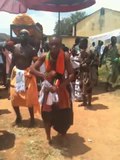
Traditional Adowa dance form and music performance.
Ghanaian dance is as diverse as its music, and there are traditional dances and different dances for different occasions.[211] The most known Ghanaian dances are those for celebrations. These dances include the Adowa, Kpanlogo, Azonto, Klama, and Bamaya.
Film


In recent times there has been some collaboration between Ghanaian and Nigerian crew and cast with a number of productions being turned out. Many Ghanaian films are co-produced with Nollywood, the Nigerian film industry and some are distributed by Nigerian marketers. Also, Nigerian filmmakers usually feature Ghanaian actors and actresses in their movies and Ghanaian filmmakers feature Nigerian actors and actresses in theirs. Nadia Buari, Yvonne Nelson, Lydia Forson and Jackie Appiah all popular Ghanaian actresses and Van Vicker and Majid Michel both popular Ghanaian actors, have starred in many Nigerian movies. As a result of these collaborations, Western viewers oftentimes confused Ghanaian movies with Nollywood and count their sales as one; however, they are two independent industries that sometimes share the colloquial Nollywood. In 2009, Unesco described Nollywood as being the second-biggest film industry in the world after Bollywood.
Media
Main article: Media of Ghana

Ghana mass media, news and information provided by television
Media freedoms were restored in 1992, and after the election in 2000 of John Agyekum Kufuor the tensions between the private media and government decreased. Kufuor was a supporter of press freedom and repealed a libel law, though maintained that the media had to act responsibly. The Ghanaian media has been described as "one of the most unfettered" in Africa, operating with little restriction on private media. The private press often carries criticism of government policy.
Sports
Main article: Sports in Ghana
See also: Ghana at the Winter Olympics and Ghana at the Olympics

The Ghanaian national football team squad that was crowned Champions of the 1965 African Cup of Nations in the year 1965 with the Trophy of the Africa Cup of Nations.

Black Stars goal celebration; football is the most popular sport in Ghana.
Ghanaian football teams Asante Kotoko SC and Accra Hearts of Oak SC are the 5th and 9th best football teams on the Africa continent and have won a total of five Africa continental association football and Confederation of African Football trophies; Ghanaian football club Asante Kotoko SC has been crowned two-time CAF Champions League winners in 1970, 1983 and five-time CAF Champions League runners up, and Ghanaian football club Accra Hearts of Oak SC has been crowned 2000 CAF Champions League winner and two-time CAF Champions League runners up, 2001 CAF Super Cup champions and 2004 CAF Confederation Cup champions. The International Federation of Football History and Statistics crowned Asante Kotoko SC as the African club of the 20th century. There are several club football teams in Ghana that play in the Ghana Premier League and Division One League, both administered by the Ghana Football Association.

Ghana finished 47th out of 102 participating nations, of whom 54 finished in the Alpine skiing slalom. Kwame Nkrumah-Acheampong broke on the international skiing circuit, being the second black African skier to do so.
Ghanaian athletes have won a total of four Olympics medals in thirteen appearances at the Summer Olympics, three in boxing, and a bronze medal in association football, and thus became the first country on the Africa continent to win a medal at association football.
The country has also produced quite a few quality boxers, including Azumah Nelson a three-time world champion and considered as Africa's greatest boxer,[233][234] Nana Yaw Konadu also a three-time world champion,[234] Ike Quartey,[234] and Joshua Clottey.[234]
Cultural heritage and architecture
See also: Ghana's material cultural heritage and Ghanaian museums

Ghanaian postmodern architecture and high-tech architecture.
Ghanaian postmodern architecture and high-tech architecture buildings are predominant in the Ghanaian southern regions, while the Ghanaian heritage sites are most evident by the more than thirty forts and castles built in Ghana. Some of these forts are Fort William and Fort Amsterdam. Ghana has museums that are situated inside castles, and two are situated inside a fort. The Military Museum and the National Museum organise temporary exhibitions.
Ghana has museums that show a in-depth look at specific Ghanaian regions, there are a number of museums that provide insight into the traditions and history of their own geographical area in Ghana.[236] The Cape Coast Castle Museum and St. Georges Castle (Elmina Castle) Museum offer guided tours. The Museum of Science and Technology provides its visitors with a look into the domain of Ghanaian scientific development, through exhibits of objects of scientific and technological interest.[236]
National symbols


The flag of Ghana consists of three horizontal bands (strips) of red (top), gold (middle) and green (bottom); the three bands are the same height and width; the middle band bears a five-pointed black star in the centre of the gold band, the colour red band stands for the blood spilled to achieve the nation's independence: gold stands for Ghana's industrial mineral wealth, and the color green symbolises the rich tropical rainforests and natural resources of Ghana.[48][237]
Tourism
Main article: Tourism in Ghana
In 2011, 1,087,000 tourists visited Ghana.Tourist arrivals to Ghana include: South Americans, Asians, Europeans, and North Americans. The attractions and major tourist destinations of Ghana include a warm, tropical climate year-round; diverse wildlife; exotic waterfalls such as Kintampo Waterfalls and the largest waterfall in west Africa, Wli Waterfalls; Ghana's coastal palm-lined sandy beaches; caves; mountains, rivers; meteorite impact crater and reservoirs and lakes such as Lake Bosumtwi or Bosumtwi meteorite crater and the largest man-made lake in the world by surface area, Lake Volta; dozens of castles and forts; UNESCO World Heritage Sites; nature reserves and national parks.
The World Economic Forum statistics in 2010 showed that out of the world's favourite tourist destinations, Ghana was ranked 108th out of 139 countries. The country had moved two places up from the 2009 rankings. In 2011, Forbes magazine, published that Ghana was ranked the eleventh most friendly country in the world. The assertion was based on a survey in 2010 of a cross-section of travellers. Of all the African countries that were included in the survey, Ghana ranked highest. Tourism is the fourth highest earner of foreign exchange for the country. In 2014, Ghana ranks as the 61st–most peaceful country in the world.
To enter Ghana, it is necessary to have a visa authorised by the Government of Ghana. Travelers must apply for this visa at a Ghanaian embassy; this process can take approximately two weeks. By law, visitors entering Ghana must be able to produce a yellow fever vaccination certificate.

Panorama view of Kakum National Park, located in the coastal environs of the Central region on the Gulf of Guinea and Atlantic Ocean, covers an area of 375 square kilometres (145 sq mi). Established in 1931 as a Game reserve and Nature reserve, it was gazetted as a national park only in 1992 after an initial survey of avifauna was conducted. The national park is covered with tropical rainforest. Kakum National Park is the only national park in Africa with a canopy walkway, which is 350 metres (1,150 ft) long and connects seven canopy tree tops which provides access to the rainforests.

No comments:
Post a Comment